
Prognostic and therapeutic significance of microbial cell-free DNA in plasma of people with acute decompensation of cirrhosis
Highlights
- •A non-hepatotropic viral signature was identified in individuals with AD of cirrhosis.
- •This viral signature correlated with clinical outcomes.
- •CMV reactivation might play a pathogenic role in AD and progression toward ACLF.
- •Further refinement and validation are needed to define the clinical relevance of our results.
Background & Aims
Although the effect of bacterial infection on cirrhosis has been well-described, the effect of non-hepatotropic virus (NHV) infection is unknown. This study evaluated the genome fragments of circulating microorganisms using metagenomic next-generation sequencing (mNGS) in individuals with acute decompensation (AD) of cirrhosis, focusing on NHVs, and related the findings to clinical outcomes.
Methods
Plasma mNGS was performed in 129 individuals with AD of cirrhosis in the study cohort. Ten healthy volunteers and 20, 39, and 81 individuals with stable cirrhosis, severe sepsis and hematological malignancies, respectively, were enrolled as controls. Validation assays for human cytomegalovirus (CMV) reactivation were performed in a validation cohort (n = 58) and exploratory treatment was instituted.
Results
In the study cohort, 188 microorganisms were detected in 74.4% (96/129) of patients, including viruses (58.0%), bacteria (34.1%), fungi (7.4%) and chlamydia (0.5%). A NHV signature was identified in individuals with AD, and CMV was the most frequent NHV, which correlated with the clinical effect of empirical antibiotic treatment, progression to acute-on-chronic liver failure, and 90-day mortality. The NHV signature in individuals with acute-on-chronic liver failure was similar to that in those with sepsis and hematological malignancies. CMV was detected in 24.1% (14/58) of patients in the validation cohort. Of the 14 cases with detectable CMV by mNGS, nine were further validated by real-time PCR or pp65 antigenemia testing. Three patients with CMV reactivation received ganciclovir therapy in an exploratory manner and experienced clinical resolutions.
Conclusions
The results of this study suggest that NHVs may play a pathogenic role in complicating the course of AD. Further validation is needed to define whether this should be incorporated into the routine management of individuals with AD of cirrhosis.
Impact and implications
A non-hepatotropic virus (NHV) signature, which was similar to that in individuals with sepsis and hematological malignancies, was identified in individuals with acute decompensation of cirrhosis. The detected viral signature had clinical correlates, including clinical efficacy of empirical antibiotic treatment, progression to acute-on-chronic liver failure and short-term mortality. Cytomegalovirus reactivation, which is treatable, may adversely affect clinical outcomes in some individuals with decompensated cirrhosis. Routine screening for NHVs, especially cytomegalovirus, may be useful for the management of individuals with acute decompensation of cirrhosis.
Graphical abstract
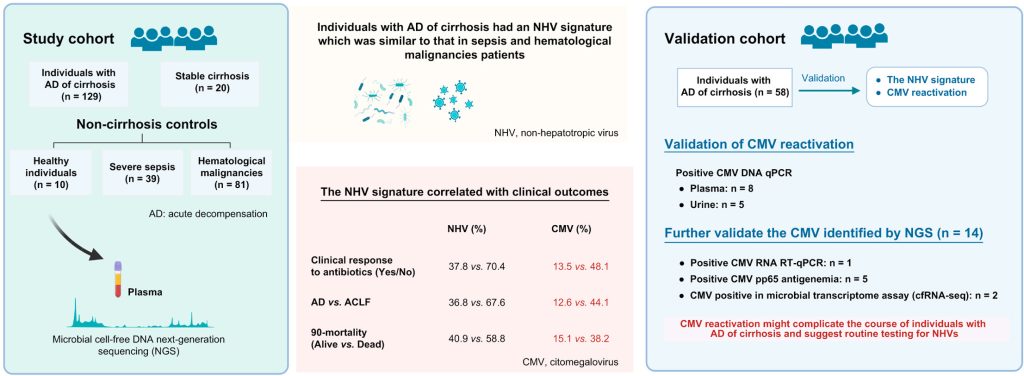
肝硬化急性失代偿期患者血浆微生物游离DNA的检测及其预后意义
背景:虽然细菌感染对肝硬化的影响已被充分描述,但非嗜肝病毒(NHV)感染的影响尚不清楚。本研究使用宏基因组下一代测序(mNGS)评价了肝硬化急性失代偿(AD)个体中循环微生物的基因组片段,重点关注NHV,并将结果与临床结局相关联。
方法:在研究队列中的129例AD肝硬化个体中进行血浆mNGS。10名健康志愿者和20、39和81名分别患有稳定性肝硬化、严重脓毒症和血液学恶性肿瘤的个体作为对照。在验证队列(n = 58)中进行人巨细胞病毒(CMV)再激活的验证试验,并开始探索性治疗。
结果:在研究队列中,74.4%(96/129)的患者检出188种微生物,包括病毒(58.0%)、细菌(34.1%)、真菌(7.4%)和衣原体(0.5%)。在AD患者中发现了NHV特征,CMV是最常见的NHV,与经验性抗生素治疗的临床效果、进展为慢加急性肝衰竭和90天死亡率相关。慢加急性肝衰竭患者的NHV特征与脓毒症和血液系统恶性肿瘤患者相似。验证队列中24.1%(14/58)的患者检出CMV。在14例mNGS可检测到CMV的病例中,9例通过实时PCR或pp 65抗原血症检测进一步验证。3例CMV再激活患者以探索性方式接受更昔洛韦治疗,并出现临床缓解。
结论:本研究结果提示NHV可能在AD病程的复杂化中起致病作用。需要进一步验证,以确定是否应将其纳入肝硬化AD患者的常规管理。
在肝硬化急性失代偿个体中发现了一种非嗜肝性病毒(NHV)特征,与败血症和血液系统恶性肿瘤个体相似。检测到的病毒特征具有临床相关性,包括经验性抗生素治疗的临床疗效、进展为慢加急性肝衰竭和短期死亡率。巨细胞病毒再激活是可以治疗的,但可能对一些失代偿期肝硬化患者的临床结局产生不利影响。常规筛查NHV,尤其是巨细胞病毒,可能有助于肝硬化急性失代偿个体的管理。